

## Introduction to the Mechanic Diesel Trade
The **Mechanic Diesel** trade is one of the most vital engineering branches under the Craftsmen Training Scheme (CTS) offered by Industrial Training Institutes (ITIs). A diesel mechanic is a technician specialized in the repair, maintenance, and overhauling of **Internal Combustion (IC) Engines** that operate on diesel fuel.
Diesel engines are the workhorses of the global economy, powering heavy-duty transport, industrial machinery, and critical power infrastructure. This trade provides students with a blend of theoretical knowledge and hands-on practical skills required to diagnose and rectify faults in modern diesel-powered systems.
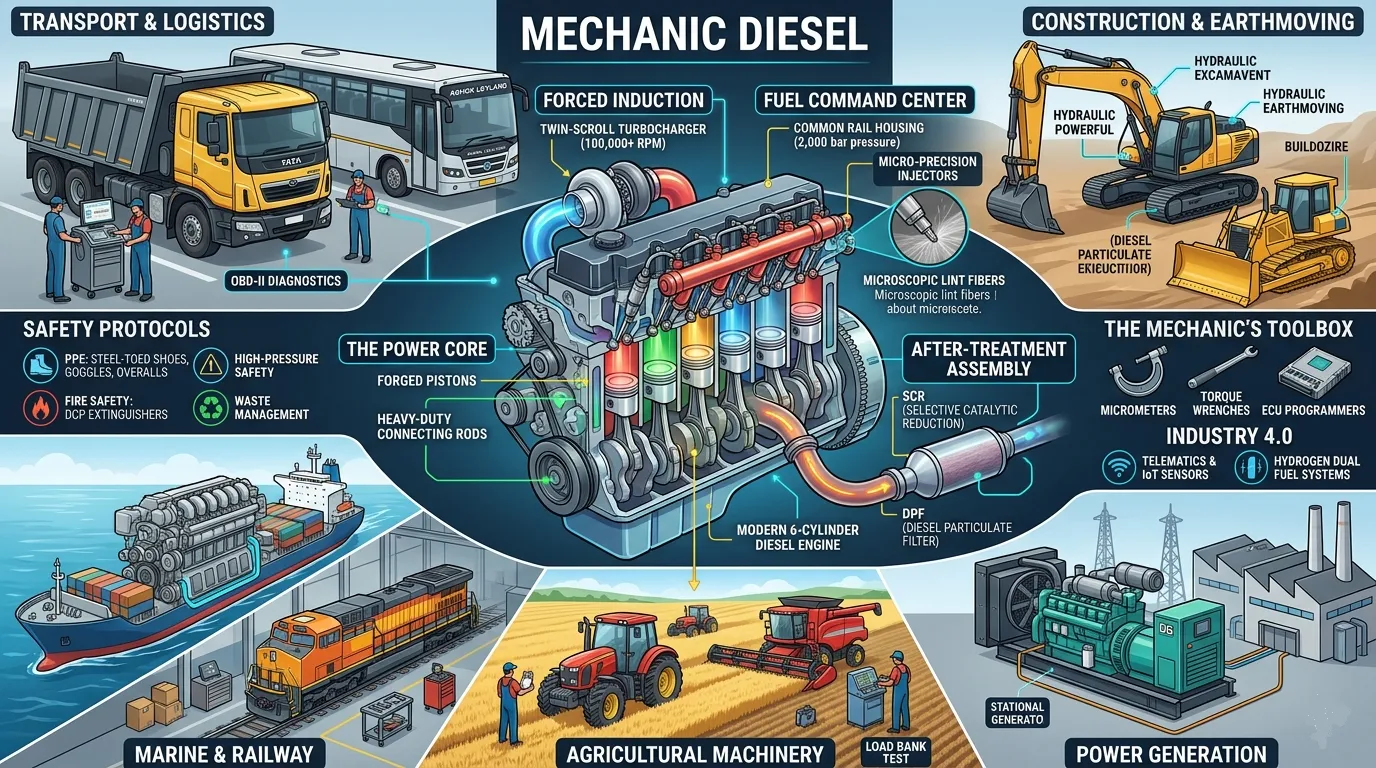
## Scope of the Mechanic Diesel Trade
The scope of this trade is vast and continues to expand as technology evolves. A qualified Diesel Mechanic has diverse career opportunities across several sectors:
### 1. Transportation and Logistics
This is the primary sector for employment. Mechanics work on **Heavy Motor Vehicles (HMV)** such as trucks, buses, and trailers. With the rise of logistics companies and e-commerce, the demand for skilled technicians to maintain transport fleets is at an all-time high.
### 2. Construction and Earthmoving Equipment
The infrastructure sector relies heavily on diesel-powered machinery. Skilled mechanics are needed to maintain:
* **Excavators** and **Backhoes**.
* **Bulldozers** and **Loaders**.
* **Road Rollers** and **Concrete Mixers**.
### 3. Agricultural Machinery
In rural and agricultural economies, the diesel mechanic plays a crucial role in maintaining **Tractors**, **Power Tillers**, and **Harvesters**, ensuring food security and agricultural productivity.
### 4. Power Generation (DG Sets)
Diesel generators (**DG Sets**) are the primary backup power sources for hospitals, factories, shopping malls, and data centers. Mechanics are employed to perform routine maintenance and emergency repairs on these high-capacity stationary engines.
### 5. Marine and Railway Engineering
* **Marine Engines:** Maintenance of diesel engines on fishing boats, cargo ships, and tugs.
* **Railways:** Maintenance of **Diesel-Electric Locomotives** in railway workshops.
—
## Key Technical Responsibilities
A professional diesel mechanic is expected to master the following technical areas:
* **Engine Overhauling:** Dismantling the engine block, inspecting the **Crankshaft**, **Connecting Rods**, and **Pistons**, and reassembling them to manufacturer specifications.
* **Fuel Injection Systems:** Servicing the **Fuel Injection Pump (FIP)** and calibrating **Injectors** to ensure proper atomization and combustion.
* **Diagnostic Procedures:** Using modern **Diagnostic Scanners** and tools to identify electronic control unit (ECU) faults in modern **Common Rail Direct Injection (CRDI)** engines.
* **Turbocharging and Induction:** Maintaining **Turbochargers** and **Intercoolers** to ensure optimal air intake and engine efficiency.
* **Emission Control:** Understanding and servicing **Exhaust Gas Recirculation (EGR)** systems and **Selective Catalytic Reduction (SCR)** to meet environmental standards like **BS-VI**.
—
## Safety Notes for the Diesel Workshop
Safety is the cornerstone of workshop practice. Because diesel mechanics work with heavy components, high-pressure systems, and flammable fluids, the following protocols are mandatory:
* **Personal Protective Equipment (PPE):** Always wear **Steel-toed Safety Shoes**, **Industrial Overalls (Boiler Suits)**, and **Safety Goggles** to protect against spills and falling objects.
* **Fire Safety:** Diesel is combustible. Always keep **Fire Extinguishers** (Dry Chemical Powder type) accessible and maintain a “No Smoking” policy in the vicinity of fuel systems.
* **High-Pressure Safety:** Never test a fuel injector against your skin. The high-pressure spray can cause a **Fuel Injection Injury**, which is a medical emergency.
* **Lifting and Rigging:** Use **Chain Hoists** or **Engine Cranes** when removing heavy components like the **Cylinder Head** or the entire engine block. Never work under a vehicle supported only by a jack; always use **Jack Stands**.
* **Waste Management:** Dispose of used **Engine Oil**, **Coolant**, and oil-soaked rags in designated hazardous waste containers to prevent environmental contamination and slip hazards.
—
## Conclusion
The Mechanic Diesel trade is a foundational pillar of the automotive and industrial sectors. By mastering the **Compression Ignition (CI)** engine, a trainee opens doors to a stable and rewarding career path, ranging from workshop technician to service manager or even an independent garage owner. As technology shifts toward more efficient and cleaner diesel systems, the demand for “smart” mechanics who understand both mechanical hardware and electronic software continues to grow.
# 🛠️ Master Class: Scope of the Mechanic Diesel Trade
## 🔍 The Core Concept
The Diesel Engine is the **”Iron Heart”** of global logistics, powering everything from massive container ships to the heavy trucks that keep India’s economy moving. As a Mechanic Diesel, you are not just a repairman; you are a **Precision Specialist** responsible for the lifeblood of transport and power generation. Your mastery ensures that high-compression machines operate at peak efficiency, minimizing carbon footprints while maximizing industrial output.
—
## 📐 Technical Breakdown & Visual Walkthrough
Imagine you are hovering over a **High-Definition 3D Cutaway** of a modern **6-Cylinder BS-VI Diesel Engine**. This is your workspace:
* **The Power Core (Internal Anatomy):** Visualize the **Cross-section** of the Cylinder Block. See the heavy-duty forged pistons moving within honed liners, designed to withstand pressures that would crush ordinary metal.
* **The Fuel Command Center (CRDi System):** Look closely at the **Common Rail housing**. It’s a high-pressure manifold that holds diesel at staggering pressures (up to 2,000 bar). Notice the **Micro-Precision Injectors**—internals so fine that a single speck of dust can cause a system failure.
* **The Forced Induction Unit (Turbocharger):** Observe the **Twin-Scroll Turbine**. It spins at over 100,000 RPM, glowing cherry red under load, requiring a perfect film of oil to survive.
* **The After-Treatment Assembly:** This is the modern “Clean Lung.” See the **Selective Catalytic Reduction (SCR)** unit and the **Diesel Particulate Filter (DPF)**, where chemical reactions turn toxic NOx into harmless nitrogen and water.
—
## ⚙️ Standard Industrial Workflow
In a professional Indian workshop (like **Ashok Leyland** or **Cummins**), we follow the **”Precision-Five”** method:
1. **Diagnostic Interrogation:** Before turning a wrench, use an **OBD-II Scanner** to read the Engine Control Unit (ECU) fault codes. Listen to the engine—a master knows the difference between a “valve tap” and a “bearing knock.”
2. **Safety & Isolation:** Secure the vehicle using heavy-duty jack stands. Implement **Lock-Out Tag-Out (LOTO)** procedures, especially on stationary industrial generators.
3. **Clean-Room Disassembly:** When opening fuel lines, use **silicone plugs** immediately. In the diesel world, **”Dirt is the Number One Enemy.”**
4. **Component Calibration:** Use micrometers and torque wrenches. Every bolt has a specific “Stretch Value.” Following the manufacturer’s torque sequence is the difference between a fix and a failure.
5. **Performance Validation:** Conduct a **Load Bank Test** or a Dyno-run to ensure the engine delivers its rated Horsepower and Torque without overheating.
—
## 🏭 Indian Industrial Case Study: The “Lifeline of India”
In the bustling **Tata Motors Service Hub** in Dharwad, Karnataka, a fleet of **Prima Heavy Tippers** arrives for a 50,000 km overhaul. These machines work in dusty mining environments.
**The Challenge:** Several engines show premature power loss.
**The Mechanic Diesel’s Role:** The specialist doesn’t just change the oil. They analyze the **Turbocharger inlet** for “dust dusting,” inspect the **Intercooler** for leaks, and recalibrate the **BS-VI AdBlue dosing unit**. By applying the “Scope of Trade” skills learned in the ITI, the mechanic saves the logistics company lakhs in fuel wastage and prevents a total engine seizure, keeping the supply chain moving.
—
## 🚀 Future-Ready: Industry 4.0 & Beyond
The “Mechanic Diesel” trade is evolving into **”Diesel-Mechatronics.”** You must prepare for:
* **Digital Twins:** Using AR (Augmented Reality) glasses to see “through” the engine block while performing repairs.
* **Telematics:** Monitoring engine health in real-time from a thousand kilometers away using **IoT Sensors**.
* **Hydrogen-Diesel Dual Fuel:** Learning to modify traditional diesel blocks to run on **Green Hydrogen**, reducing emissions to near zero.
* **Predictive AI Maintenance:** Software that tells you a fuel pump will fail *three days before* it actually does.
—
## 💡 The Workshop Secret (Pro-Tip)
**”The 1-Micron Rule”:** Most trainee mechanics think a clean rag is enough. **It isn’t.** Modern Diesel Fuel Injectors have clearances smaller than a human red blood cell.
**The Pro-Tip:** Never use a cotton rag to wipe a fuel injector tip—the microscopic lint fibers stay behind and can clog the nozzle. Always use **lint-free industrial wipes** or compressed air. **A clean engine starts with a clean mind and a clean bench!** 🧼🔩