
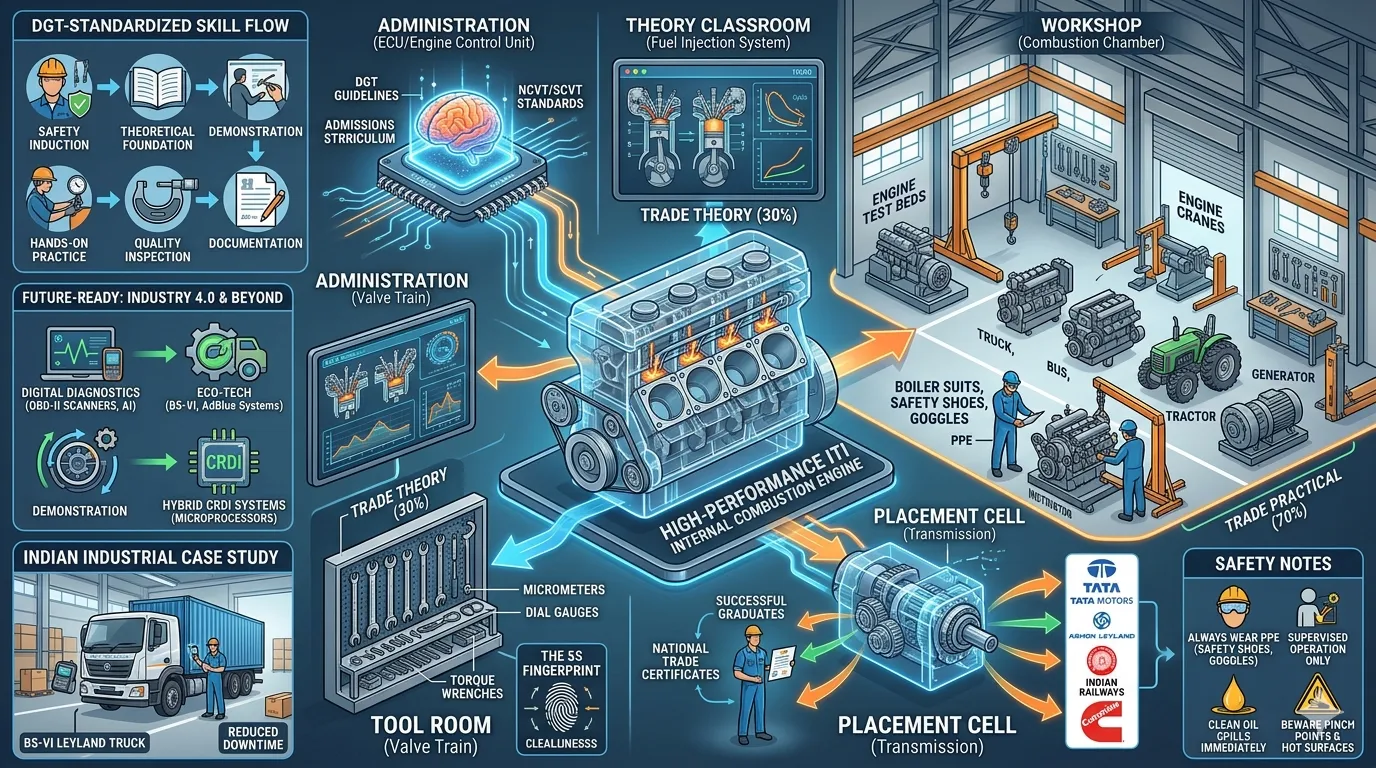
Module: Safety Workshop Practices
Lesson: Organization of ITI’s and Scope of the Mechanic Diesel Trade
Topic: Brief Introduction of ITIs
Overview
Welcome to your first step toward becoming a professional technician. In this lesson, we explore the foundation of your training environment: the **Industrial Training Institute (ITI)**. Understanding the structure and purpose of these institutes is essential for every trainee entering the **Mechanic Diesel** trade. ITIs serve as the backbone of industrial growth by providing a steady stream of skilled manpower to various sectors, ensuring that theoretical knowledge is seamlessly integrated with hands-on practical expertise.
Key Technical Points
1. What is an ITI?
An “Industrial Training Institute (ITI)” is a post-secondary school in India constituted under the “Directorate General of Training (DGT)”, Ministry of Skill Development and Entrepreneurship. The primary goal is to provide technical manpower to industries through vocational training.
Training Scheme: Most ITIs operate under the “Craftsmen Training Scheme (CTS).
Certification: Certificates are generally issued by the “National Council for Vocational Training (NCVT) or the “State Council for Vocational Training (SCVT)”. An “National Trade Certificate (NTC) is highly valued by both public and private sector employers.
2. Organizational Structure
An ITI is organized to simulate a real-world industrial environment. Key components include:
* **Administrative Wing:** Handles admissions, examinations, and certifications.
* **Instructional Wing:** Comprises **Trade Instructors** and **Training Officers** who guide students through **Trade Theory** and **Trade Practical** sessions.
* **Workshop:** The heart of the ITI where trainees work with actual engines, tools, and diagnostic equipment.
* **Placement Cell:** Assists successful trainees in securing apprenticeships or full-time jobs in industries.
#### 3. Introduction to the Mechanic Diesel Trade
The **Mechanic Diesel** trade is a specialized vocational branch focused on the operation, maintenance, and repair of internal combustion engines that run on diesel fuel.
* **Duration:** Typically a 1-year course divided into two semesters (or annual pattern).
* **Core Skills:** You will learn to dismantle, inspect, repair, and reassemble diesel engines found in trucks, buses, tractors, and stationary power generators.
* **Scope:** With the rise of heavy infrastructure and transport logistics, skilled diesel mechanics are in high demand for maintaining commercial fleets and heavy machinery.
#### 4. The Learning Approach: 70/30 Rule
Vocational training in an ITI emphasizes practical skills.
* **Practical Training (70%):** Majority of the time is spent in the workshop performing hands-on tasks.
* **Theoretical Knowledge (30%):** Classroom sessions cover the “why” and “how” behind engine mechanics, including **Workshop Calculation & Science** and **Engineering Drawing**.
—
### Safety Notes for the ITI Workshop
In a vocational setting, safety is not just a rule; it is a discipline. Before you handle any tool in the **Mechanic Diesel** workshop, remember these fundamental points:
1. **Personal Protective Equipment (PPE):** Always wear **Steel-toed Safety Shoes**, **Boiler Suits (Overalls)**, and **Safety Goggles** when working near running engines or heavy components.
2. **Shop Floor Discipline:** Never operate a machine or start a diesel engine without the explicit permission and supervision of your **Trade Instructor**.
3. **Tool Hygiene:** Keep your designated workstation clean. Oil spills must be cleaned immediately using sawdust or cleaning agents to prevent slip-and-fall accidents.
4. **Awareness:** Be mindful of “Pinch Points” on engines and “Hot Surfaces” such as exhaust manifolds.
—
### Summary for the Trainee
The ITI system is designed to transform a student into a **Skilled Craftsman**. As a trainee in the **Mechanic Diesel** trade, your journey begins with understanding the institute’s rules and respecting the workshop environment. Your success depends on your ability to combine technical theory with the precision of manual labor.
# 🛠️ Master Class: Brief Introduction of ITIs
## 🔍 The Core Concept
Industrial Training Institutes (ITIs) are the **beating heart of India’s manufacturing engine**, designed to transform raw potential into precision-skilled technicians. For a Mechanic Diesel trainee, the ITI is not just a school; it is a **simulated industrial ecosystem** where “Learning by Doing” is the law of the land. We exist to bridge the gap between academic theory and the high-stakes reality of the heavy-machinery workshop, ensuring every student becomes a **national asset.**
—
## 📐 Technical Breakdown & Visual Walkthrough
Imagine the ITI structure as a **High-Performance Internal Combustion Engine**. To understand how it works, let’s look at its “Housing” and “Internals”:
1. **The Administration (The ECU/Engine Control Unit):** This is the brain of the institute. It manages the **DGT (Directorate General of Training)** guidelines, ensuring that your curriculum meets **NCVT (National Council for Vocational Training)** standards.
2. **The Theory Classroom (The Fuel Injection System):** This is where the “fuel” (knowledge) is prepared. You visualize the **cross-sections** of cylinder heads and cooling systems through charts and digital models before touching the actual iron.
3. **The Workshop (The Combustion Chamber):** The most vital part. It is a high-ceilinged, ventilated zone equipped with **Engine Test Beds**, heavy-duty cranes, and workbenches. Here, the “spark” of knowledge meets the “compression” of hard work, generating real-world skills.
4. **The Tool Room (The Valve Train):** A precision-organized space containing **Torque Wrenches, Micrometers, and Dial Gauges**. Everything is calibrated; if the tool room is out of sync, the whole engine (training) fails.
5. **The Placement Cell (The Transmission):** This unit takes the power generated in the workshop and transfers it to the “wheels” of the industry, connecting you to giants like **Tata Motors, Ashok Leyland, or Indian Railways.**
—
## ⚙️ Standard Industrial Workflow
In a modern ITI, we follow the **DGT-Standardized Skill Flow** to ensure you are industry-ready from day one:
1. **Safety Induction (The Pre-Start Check):** Before touching a single bolt, you are drilled in **PPE (Personal Protective Equipment)** and Fire Safety.
2. **Theoretical Foundation:** Understanding the 4-stroke cycle and Diesel properties through interactive modules.
3. **Demonstration:** The Master Trainer performs a task (e.g., Tappet adjustment) on a live engine while trainees observe the **Standard Operating Procedure (SOP)**.
4. **Hands-on Practice:** Trainees perform the task under supervision, focusing on **accuracy over speed.**
5. **Quality Inspection:** Using precision measuring tools to verify that the work meets the “Clearance & Tolerance” specifications defined in the Service Manual.
6. **Documentation:** Filling out **Job Cards**, just as you would in a professional Cummins or Mahindra workshop.
—
## 🏭 Indian Industrial Case Study: The Leyland Service Hub
In the bustling MSME clusters of **Pune or Chennai**, a breakdown in a logistics fleet can cost lakhs per hour.
* **The Scenario:** A BS-VI heavy-duty truck arrives with a “Limp Mode” error.
* **The ITI Impact:** A technician trained in a modern Diesel Mechanic trade doesn’t just “guess.” They use the **Systematic Troubleshooting** method learned in the ITI workshop. By connecting an **OBD Scanner**, identifying a choked DPF (Diesel Particulate Filter), and following the manufacturer’s torque sequence, they get the vehicle back on the road.
* **The Result:** Industrial efficiency is maintained because the technician followed the **ITI-taught discipline of “Right Tool, Right Task.”**
—
## 🚀 Future-Ready: Industry 4.0 & Beyond
The Mechanic Diesel trade is evolving from “Grease Monkey” to “Digital Technician”:
* **Digital Diagnostics:** Moving beyond stethoscopes to **AI-powered vibration analysis** and Bluetooth-enabled ECU scanners.
* **Eco-Tech:** Training now includes **AdBlue (DEF) systems** and SCR (Selective Catalytic Reduction) to meet Bharat Stage VI (BS-VI) emission norms.
* **Hybrid Integration:** Introduction to **Common Rail Direct Injection (CRDI)** systems which are governed by microprocessors, requiring a blend of mechanical grit and electronic precision.
—
## 💡 The Workshop Secret (Pro-Tip)
> **”The 5S Fingerprint”**
> An elite Mechanic Diesel professional never leaves a “footprint” of their work. **The Secret:** Always clean your tools and the engine block *as you work*, not just at the end. A clean engine reveals cracks and leaks that grease hides. If your workbench looks like a surgical tray, your diagnostic accuracy will automatically increase by 40%. **Respect the tool, and the machine will respect you!** 🛠️✨