

## Module: Safety Workshop Practices
## Lesson: Organization of ITIs and Scope of the Mechanic Diesel Trade
## Topic: General Discipline In the Institute
### Overview
In the vocational training landscape, particularly within an **Industrial Training Institute (ITI)**, discipline is not merely a set of rules but the foundation of professional excellence. For a **Mechanic Diesel** trainee, discipline translates to precision, safety, and reliability. This topic covers the essential behavioral and procedural standards expected of a trainee within the institute and the workshop environment. Adhering to these protocols ensures a productive learning atmosphere and prepares the trainee for the rigorous demands of the automotive industry.
—
### Key Technical and Procedural Points
**1. Punctuality and Attendance**
* **Time Management:** Trainees must arrive at the institute and the workshop at the designated time. In the **Mechanic Diesel** trade, missing the initial briefing (tool distribution and safety instructions) can lead to accidents.
* **Minimum Attendance:** Adherence to the statutory attendance percentage (usually 80%) is mandatory to qualify for the **All India Trade Test (AITT)**.
**2. Personal Conduct and Professionalism**
* **Chain of Command:** Trainees must follow the organizational hierarchy, reporting first to their **Trade Instructor**, then to the **Group Instructor (GI)**, and finally the **Principal** if necessary.
* **Respectful Interaction:** Professional behavior toward staff and fellow trainees is essential. Unauthorized movement between workshops is strictly prohibited.
**3. Uniform and Personal Appearance**
* **Prescribed Uniform:** Wearing the designated institute uniform (often **Dungarees** or **Boiler Suits** for diesel mechanics) is compulsory. Loose clothing is a hazard around rotating engine parts.
* **Personal Grooming:** Long hair must be tied back or covered, and nails must be kept short to prevent grease accumulation and accidental snagging in machinery.
**4. Workshop Etiquette and Tool Handling**
* **Tool Responsibility:** Every trainee is responsible for the tools issued to them. Tools must be cleaned and returned to the **Tool Room** or placed correctly on the **Shadow Board** after use.
* **Workstation Maintenance:** The concept of **5S (Sort, Set in order, Shine, Standardize, Sustain)** should be applied daily. A cluttered workspace leads to inefficiency and “tripping” hazards.
* **Prohibition of Horseplay:** Running, shouting, or playing practical jokes in the workshop is a serious disciplinary offense as it distracts others handling heavy engine components or flammable fuels.
**5. Documentation and Record Keeping**
* **Trainee Diary:** Maintaining an up-to-date daily diary and **Practical Record Book** is a disciplinary requirement. This reflects the trainee’s progress and technical understanding of diesel engines.
—
### Safety Notes for the Mechanic Diesel Trade
Safety and discipline are inseparable in a workshop containing high-compression engines, pressurized fuel systems, and heavy assemblies.
* **PPE (Personal Protective Equipment):** It is a disciplinary violation to enter the workshop floor without **Safety Shoes** (steel-toed) and **Safety Goggles** when required.
* **Handling Flammables:** Diesel fuel and cleaning solvents are combustible. Strict discipline must be maintained regarding “No Smoking” zones and the proper disposal of oily rags in **Fire-Resistant Waste Bins**.
* **Machine Operation:** Never operate any machinery (such as a **Valve Refacer** or **Fuel Injection Test Bench**) without the explicit permission and supervision of the instructor.
* **Emergency Protocols:** Trainees must discipline themselves to learn the locations of **Fire Extinguishers**, **First Aid Kits**, and **Emergency Exits** immediately upon joining the trade.
—
**Instructor’s Note:**
*Discipline in the ITI is the first step toward becoming a skilled technician. A mechanic who cannot follow institute rules will likely fail to follow critical service manual specifications, leading to mechanical failure or workplace injury.*
# 🛠️ Master Class: General Discipline In the Institute
Welcome, Trainees! I am your **Elite Industrial Master Trainer**. Today, we aren’t just talking about “rules”—we are talking about the **Industrial DNA** that separates a roadside mechanic from a world-class **Diesel Engine Specialist**. In our trade, discipline is the difference between a perfectly tuned 500HP engine and a catastrophic workshop accident.
—
## 🔍 The Core Concept
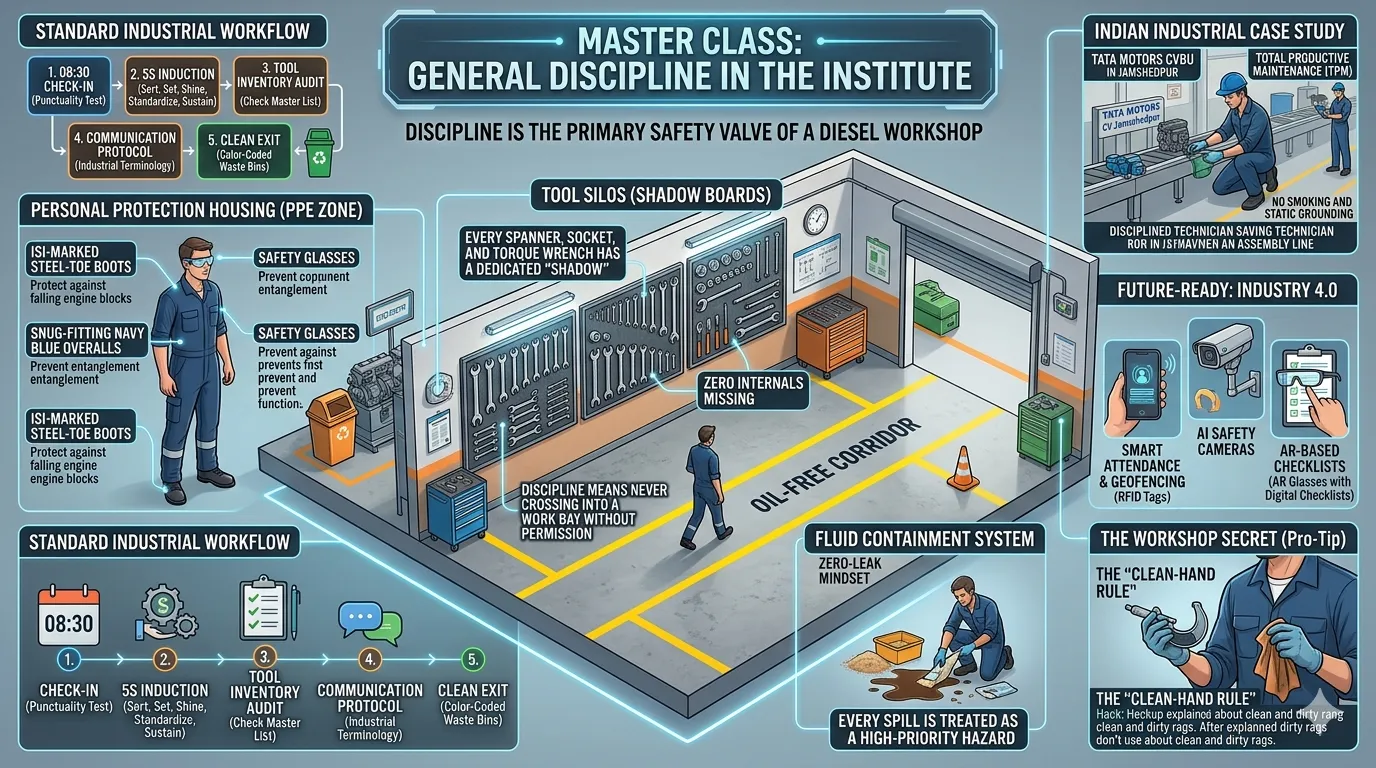
Discipline is the **primary safety valve** of a diesel workshop; without it, the high pressures and heavy components we handle become lethal. It is the commitment to doing the right thing—like wearing your PPE or torqueing a bolt to spec—even when no supervisor is watching. In the Mechanic Diesel trade, **professionalism starts at the gate**, not just at the workbench.
—
## 📐 Technical Breakdown & Visual Walkthrough
Imagine our ITI workshop as a **High-Definition 3D Model**. If you were to take a **cross-section** of a disciplined institute, you would see these four integrated “Housing Units” of discipline:
1. **The Personal Protection Housing (PPE Zone):** Every trainee functions as a “component.” You must be “installed” with ISI-marked steel-toe boots (to protect against falling engine blocks), snug-fitting navy blue overalls (no loose ends to get caught in cooling fans), and safety glasses.
2. **The Tool Silos (Shadow Boards):** Look at the walls. Every spanner, socket, and torque wrench has a dedicated “shadow.” A disciplined workshop has **zero internals missing**. If a tool is out of its housing, the system is “failing.”
3. **The Floor Architecture (Zoning):** Visualize bright **canary-yellow floor markings**. These are the “Oil-Free Corridors.” Discipline means never crossing into a work bay without permission and ensuring the “Walkway” internals are never obstructed by scrap or heavy diesel components.
4. **The Fluid Containment System:** Diesel and lubricants are the lifeblood of our trade. Discipline involves a “Zero-Leak” mindset where every spill is treated as a high-priority hazard and neutralized immediately with sawdust or spill kits.
—
## ⚙️ Standard Industrial Workflow
To survive and thrive in a modern Indian industry, you must follow the **”Professional Start-up Sequence”** daily:
1. **The 08:30 Check-In:** Punctuality is your first “Test Run.” Arriving late in industry causes a bottleneck in the entire assembly line.
2. **The 5S Induction:** Before touching an engine, you must perform **Sort, Set in Order, Shine, Standardize, and Sustain**. A clean bay is a safe bay.
3. **The Tool Inventory Audit:** Check your tool chest against the master list. A missing 10mm socket left inside a cylinder head can destroy a Lakh-rupee engine.
4. **The Communication Protocol:** Use industrial terminology. Don’t say “that pipe”; say “the high-pressure fuel rail.” Clear communication prevents errors.
5. **The Clean Exit:** At the end of the shift, all metal scrap goes to the **Red Bin**, oily rags to the **Yellow Bin**, and tools are wiped clean of grease before storage.
—
## 🏭 Indian Industrial Case Study: Tata Motors CVBU
In the **Tata Motors Commercial Vehicle Business Unit (CVBU)** in Jamshedpur, discipline is enforced through a system called **”Total Productive Maintenance” (TPM)**.
Recently, a technician saved a multi-crore assembly line from a fire because he followed the “General Discipline” of **No Smoking and Static Grounding** near the fuel-filling station. Because he maintained his discipline, the line stayed active, and thousands of trucks were delivered on time. In these plants, if a supervisor sees you running (instead of walking) or wearing loose clothing, you are pulled off the floor immediately. **Industry rewards precision, not speed.**
—
## 🚀 Future-Ready: Industry 4.0 & Beyond
Discipline is going digital! In the next few years, your ITI and future workshops will use:
* **Smart Attendance & Geofencing:** Your presence in the workshop is tracked via RFID tags in your ID cards to ensure you are in your assigned safety zone.
* **AI Safety Cameras:** Modern workshops use AI-powered CCTV that triggers an alarm if it detects a trainee **not wearing a helmet or mask**.
* **AR-Based Checklists:** You will wear Augmented Reality (AR) glasses that won’t let you start an engine until you have digitally “checked off” every safety discipline step in your field of vision.
—
## 💡 The Workshop Secret (Pro-Tip)
**”The Clean-Hand Rule”:** Experienced Masters know that a Diesel Mechanic’s greatest discipline is keeping their **technical manuals and measurement tools (like Micrometers)** 100% grease-free.
**The Hack:** Always keep a “clean rag” on your left shoulder and a “dirty rag” in your right pocket. Use the right for the engine, and the left for your hands before touching any precision instrument. **A clean tool never lies; a greasy tool hides defects.**
—
**Master Trainer’s Closing Note:** *Class, remember—an engine follows the laws of physics without fail. You must follow the laws of the workshop with the same consistency. Dismissed to the bays!*