

## Module: Safety Workshop Practices
## Lesson: Organization of ITI’s and Scope of the Mechanic Diesel Trade
## Topic: Self-Employment Opportunities of the Mechanic Diesel Trade
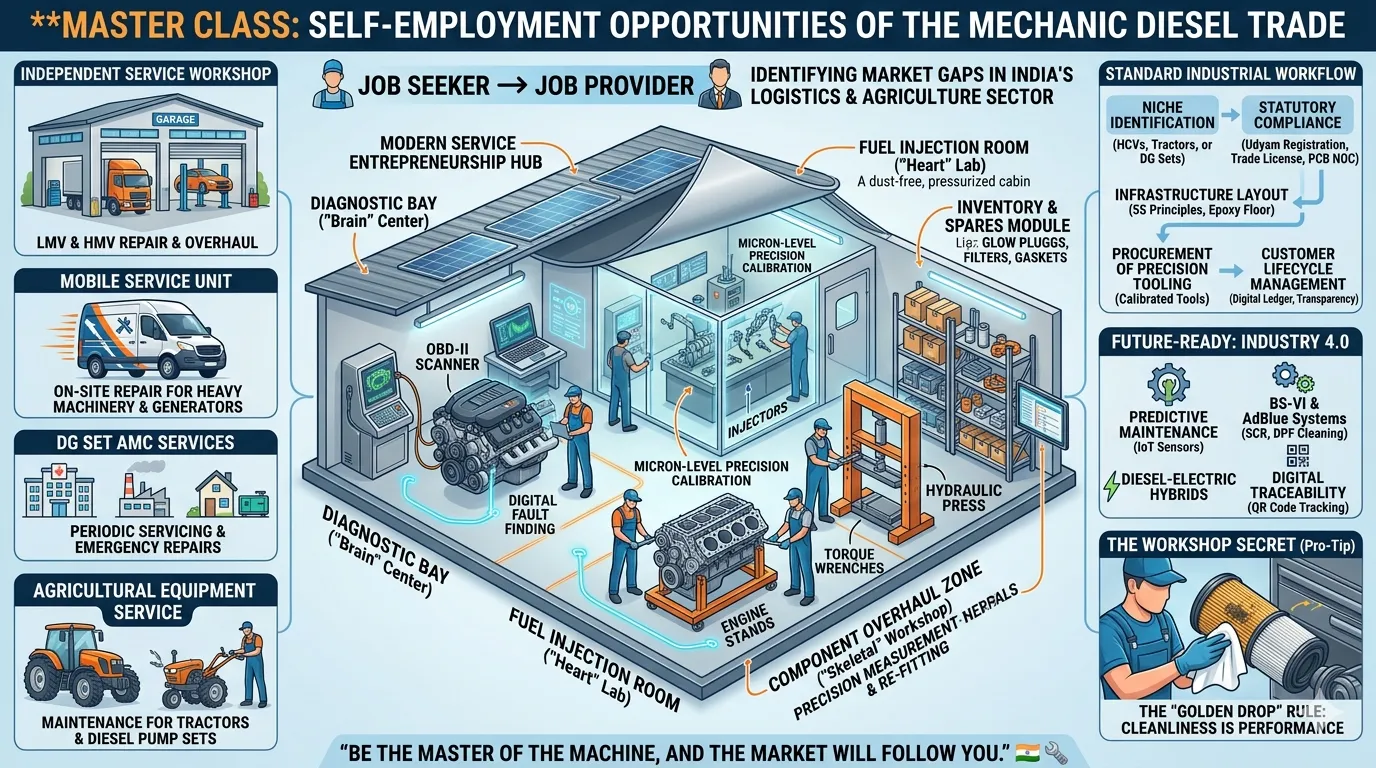
### Overview
The **Mechanic Diesel** trade is one of the most versatile and high-demand vocational paths within the industrial training ecosystem. While many graduates seek employment in large-scale automotive manufacturing or government sectors (such as Railways or State Transport), the trade offers vast potential for **Self-Employment (Entrepreneurship)**.
Diesel engines are the backbone of the logistics, agriculture, and power generation sectors. As a trained technician, you possess the technical expertise to troubleshoot, repair, and maintain high-compression engines. Transitioning from a technician to a business owner requires not only technical skill but also an understanding of market needs and workshop management.
—
### Key Self-Employment Opportunities
A certified Diesel Mechanic can venture into several profitable business models:
* **Independent Service Workshop:** Establishing a private garage focused on the repair and overhauling of Light Motor Vehicles (LMV) and Heavy Motor Vehicles (HMV). This includes engine tuning, brake adjustments, and general maintenance.
* **Fuel Injection Pump (FIP) Service Center:** This is a highly specialized niche. Setting up a laboratory to calibrate and repair **Fuel Injectors** and **Injection Pumps** using a **Test Bench** is a lucrative business due to the precision required.
* **Spare Parts Dealership:** Combining technical knowledge with retail by opening a shop for genuine diesel engine components, filters, and specialized lubricants.
* **Mobile Service Unit:** Providing “on-site” repair services for heavy machinery, such as backhoe loaders or stationary generators, that cannot be easily transported to a workshop.
* **Annual Maintenance Contracts (AMC) for Generators:** Many hospitals, apartment complexes, and factories rely on **Diesel Generator (DG) Sets**. A mechanic can sign contracts for periodic servicing and emergency repairs.
* **Agricultural Equipment Service:** In rural and semi-urban areas, providing specialized maintenance for **Tractors**, **Power Tillers**, and **Diesel Pump Sets** is a vital and steady source of income.
—
### Technical Requirements for Starting a Venture
To succeed in self-employment, a mechanic must invest in specific **Tools and Equipment**:
1. **General Tools:** A comprehensive set of **Double Ended Spanners**, **Ring Spanners**, **Socket Sets**, and **Torque Wrenches**.
2. **Diagnostic Tools:** **Compression Testers**, **Vacuum Gauges**, and modern **OBD-II Scanners** for electronic diesel control systems.
3. **Precision Instruments:** **Outside Micrometers**, **Vernier Calipers**, and **Feeler Gauges** for measuring engine clearances.
4. **Handling Equipment:** **Hydraulic Jacks**, **Jack Stands**, and **Chain Pulleys** for safe engine removal and vehicle lifting.
—
### Professional Skills for Success
Beyond turning a wrench, a self-employed professional must master:
* **Troubleshooting & Diagnostics:** The ability to accurately identify a fault saves time and builds customer trust.
* **Customer Relations:** Effective communication and transparency regarding repair costs and timelines.
* **Financial Management:** Basic bookkeeping, invoicing, and managing overhead costs like rent and electricity.
—
### Safety Notes for the Self-Employed Mechanic
In your own workshop, you are the **Safety Officer**. Adhering to safety standards prevents injuries and legal liabilities:
* **Personal Protective Equipment (PPE):** Always wear **Steel-Toed Safety Shoes**, **Industrial Overalls**, and **Oil-Resistant Gloves**. Use **Safety Goggles** when using grinders or compressed air.
* **Workshop Layout:** Ensure there is adequate ventilation to prevent the buildup of toxic **Carbon Monoxide (CO)** fumes. Keep floors free of oil spills to prevent slips and falls.
* **Fire Safety:** Keep functional **Fire Extinguishers** (Class B for oil/grease and Class C for electrical) easily accessible. Diesel is combustible; never smoke near fuel storage.
* **Waste Management:** Dispose of used **Engine Oil**, **Coolant**, and old **Lead-Acid Batteries** according to environmental regulations. Never pour oil into public drains.
* **Tool Maintenance:** Never use mushroomed chisels or cracked sockets. A faulty tool is a primary cause of workplace accidents.
—
### Conclusion
The scope of the **Mechanic Diesel** trade is not limited to working for others. With the right mix of technical proficiency, safety discipline, and entrepreneurial spirit, an ITI graduate can become a job creator rather than a job seeker, contributing significantly to the local economy and the industrial sector.
# 🛠️ Master Class: Self Employment Opportunities of the Mechanic Diesel Trade
## 🔍 The Core Concept
Self-employment in the Mechanic Diesel trade is about transforming from a **Job Seeker** into a **Job Provider** by identifying gaps in the massive Indian logistics and agricultural sectors. It involves leveraging your technical expertise to offer specialized services—like fuel injection pump calibration or engine reconditioning—that larger workshops often outsource. By mastering the diesel engine, you aren’t just fixing machines; you are ensuring the **lifeline of Indian commerce** keeps moving.
—
## 📐 Technical Breakdown & Visual Walkthrough
Imagine your future **Service Entrepreneurship Hub** as a high-definition 3D model. Let’s peel back the roof and look at the functional **internals** of a successful self-employment unit:
1. **The Diagnostic Bay (The “Brain” Center):** A clean, well-lit area equipped with an **OBD-II Scanner** and a specialized laptop station. This is where you perform a “Digital Cross-section” of modern BS-VI engines to find faults without opening a single bolt.
2. **The Fuel Injection Room (The “Heart” Lab):** A dust-free, pressurized cabin. Inside, you see the **FIP (Fuel Injection Pump) Test Bench**. It looks like a high-tech laboratory where you calibrate injectors to micron-level precision to ensure peak fuel efficiency.
3. **The Component Overhaul Zone (The “Skeletal” Workshop):** A heavy-duty area featuring **Engine Stands** and **Hydraulic Presses**. Here, you see the engine **housing** stripped down, revealing the **internals**—the crankshaft, pistons, and liners—ready for precision measurement and re-fitting.
4. **The Inventory & Spares Module:** A vertical racking system holding high-turnover parts like **Glow Plugs, Filters, and Gaskets**, managed by simple digital inventory software.
—
## ⚙️ Standard Industrial Workflow
To transition from a trainee to a business owner, follow this **Professional Industrial Protocol**:
1. **Niche Identification:** Decide if you will focus on **Heavy Commercial Vehicles (HCVs)**, **Agricultural Tractors**, or **Stationary DG Sets**. Specialization leads to higher margins.
2. **Statutory Compliance (The Indian ‘Udyam’ Path):** Register your workshop under **MSME (Udyam Registration)**. Obtain the necessary **Trade License** and **Pollution Control Board (PCB) NOC** for waste oil disposal.
3. **Infrastructure Layout:** Design your workshop using **5S Principles**. Ensure the floor is epoxy-coated for easy oil spill cleanup and safety.
4. **Procurement of Precision Tooling:** Invest in calibrated **Torque Wrenches, Dial Gauges, and Compression Testers**. Quality work starts with accurate measurement.
5. **Customer Lifecycle Management:** Use a simple digital ledger or app to track service histories. In modern India, **trust is built through transparency.**
—
## 🏭 Indian Industrial Case Study: The “Namakkal Success Model”
In **Namakkal, Tamil Nadu** (the truck capital of India), thousands of ITI graduates have moved from mechanics to owners of specialized **”Pump Centers.”**
Instead of general repairs, these entrepreneurs focus solely on **Fuel Injection Systems**. Because modern BS-VI trucks require highly specific calibration, a small shop in Namakkal with one **Common Rail Test Bench** can service an entire fleet of 50-100 trucks. This specialized “Micro-Expertise” allows them to earn 4x more than a general mechanic while providing a vital service to the national transport industry.
—
## 🚀 Future-Ready: Industry 4.0 & Beyond
The “Mechanic Diesel” of 2024 is becoming a **”System Technician”**:
* **Predictive Maintenance:** Using IoT sensors to tell a customer their engine will fail *before* it actually does.
* **BS-VI & AdBlue Systems:** Specializing in **Selective Catalytic Reduction (SCR)** technology and DPF (Diesel Particulate Filter) cleaning—a high-demand, high-tech niche.
* **Hybridization:** Preparing for **Diesel-Electric hybrids** where you manage both the internal combustion engine and the electric powertrain components.
* **Digital Traceability:** Using QR codes on every serviced engine component to track its warranty and service life.
—
## 💡 The Workshop Secret (Pro-Tip)
**The “Golden Drop” Rule:** In the diesel world, **Cleanliness is Performance.**
*The Master’s Hack:* Always show the customer the **old parts and the debris** found in their filters or oil. Use a white lint-free cloth to wipe a “cleaned” component in front of them. When a customer sees your obsession with a dust-free environment, they stop seeing you as a “grease monkey” and start seeing you as a **Technical Consultant.** This perception allows you to charge premium rates for your expertise! 🌟
—
**”Be the master of the machine, and the market will follow you.”** 🇮🇳🔩